.png)

Embalming Enquiries
- Alyssa Cavalieri
- Jun 11, 2020
- 3 min read

Prior to the invention of embalming, natural burials and home care of bodies were the norm. Embalming rose to popularity during the Civil War, since bodies needed to be preserved in order to send them home to their families for burial. Unfortunately, they were often preserved using arsenic and other chemicals harmful to both the environment and the embalmer. In addition to this, groundwater near cemeteries dated from the Civil War is still thought to be contaminated by trace amounts of arsenic today. According to the National Museum of Civil War Medicine, embalming was invented in 1838.
"The French chemist, Jean Gannal, introduced a new method for preserving human remains in which arsenic was injected directly into the carotid artery."
The deaths of soldiers and requests from family members to see their lost loved ones again led to a big boom in embalming and quite the profit for the new industry. The National Museum of Civil War Medicine cites that Thomas Holmes, the "Father of Modern Embalming," processed approximately 4,000 corpses during the duration of the Civil War and charged $100 dollars per body. Embalming practices continued post-war, and caring for bodies was taken from the home and into the new funeral industry.
Caitlin Doughty, known by her YouTube moniker Ask A Mortician, covers the concept and process of embalming in the same video that inspired the title of this blog.
In a briefer explanation, the embalming process often begins by wiring shut the jaw, gluing the mouth into position, and closing the eyes using caps. This prevents facial features from shifting during the process, since they will no longer move once set by embalming fluid. After this, the carotid artery and jugular vein are both punctured, and while the chemical embalming fluid flows into the body through the artery, blood is pushed out through the vein. In addition to this, the main body cavity is suctioned to remove gas, fluid, and feces, and then injected with more embalming fluid and plugged, to describe it in the least graphic way possible. The body is cleaned, dressed, cosmetics are applied, and it is ready to be placed in a casket for a viewing and then buried in a vault. Doughty's video is linked for brave souls with a stomach for the more explicit details, rather than the watered down version of embalming presented above.
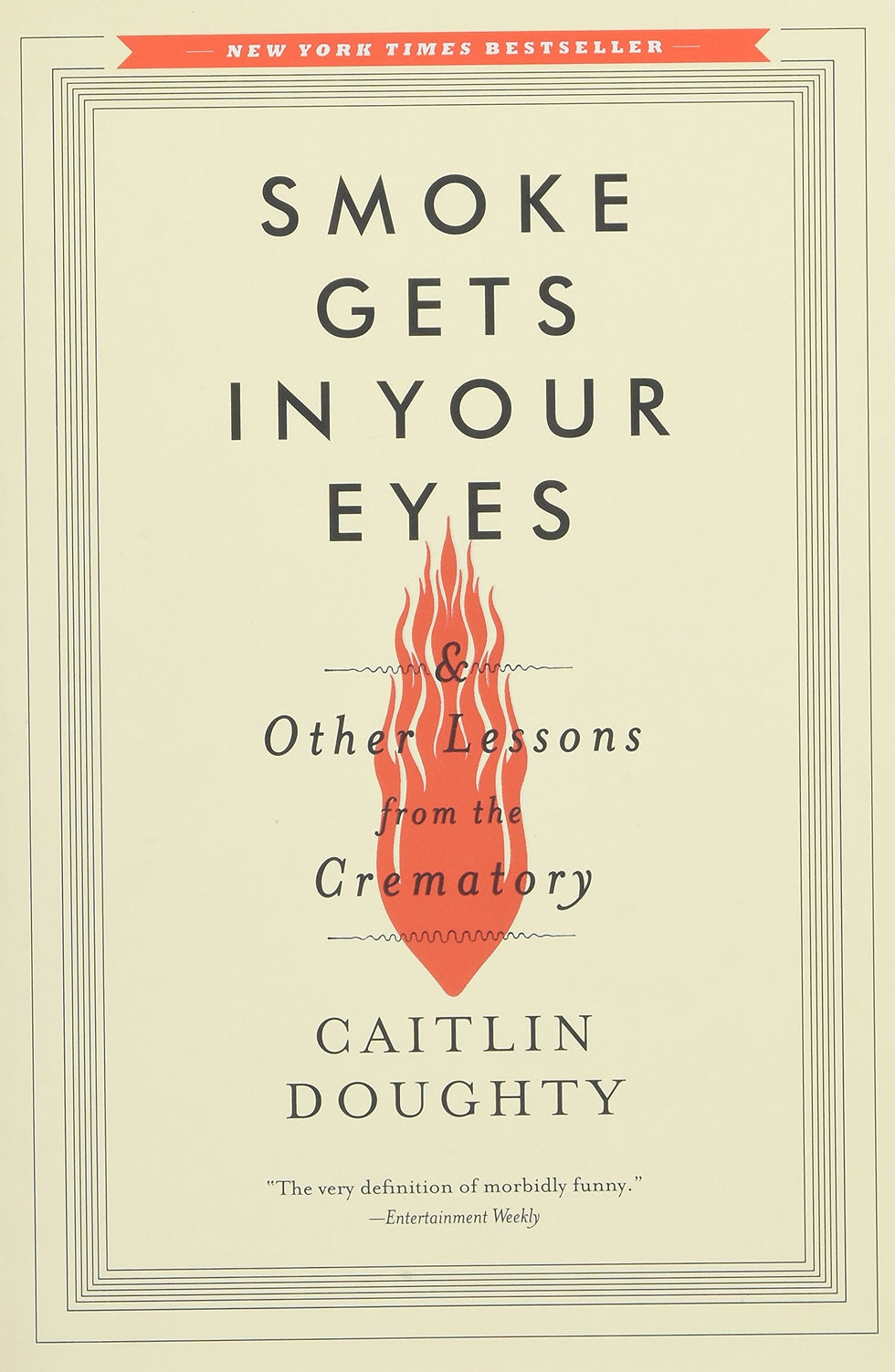
Doughty's novel contains information about the processes of both cremation and embalming:
Fortunately, arsenic is no longer a part of the practice of embalming, having been replaced by formaldehyde. However, formaldehyde and the other chemicals used for modern embalming techniques are also dangerous and morticians are required to wear protective gear while embalming a body. The toxic chemicals are still detrimental to the environment. In addition to this, embalming is usually paired with a traditional casket funeral, in which the embalmed body and not always eco-friendly casket are placed into a vault in the ground made of cement or metal. Although the practice is widespread, it is not gentle to the earth, which has inspired the invention of several new types of green burials, as well as a return to natural burial, while people become more aware of the impact that their death can have on the environment.
Until death do us part,
Alyssa
Sources & Further Reading


Comments